

From Selling Beer to Selling Nuclear Propulsion — Is Selling Really That Different?
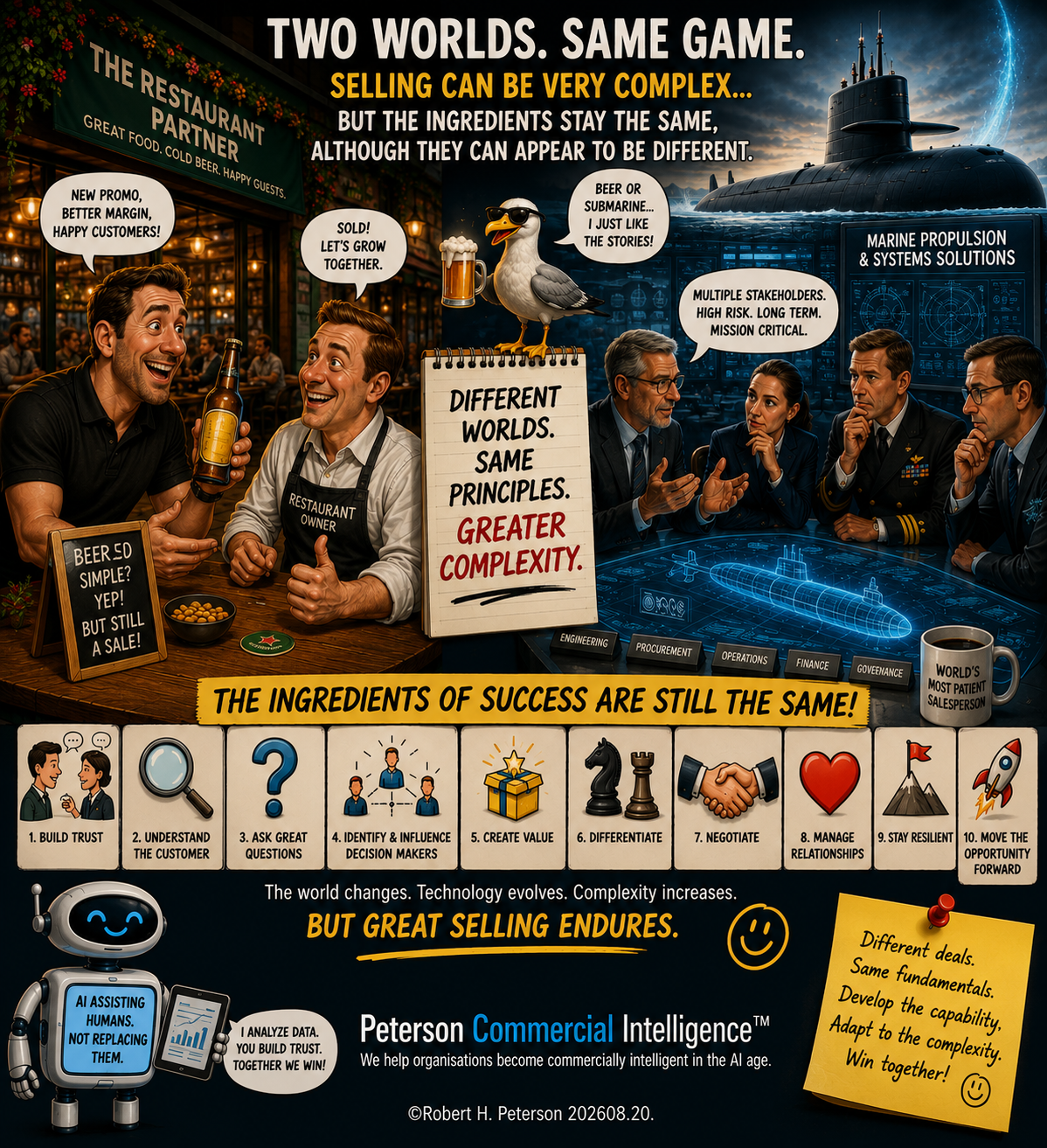
Over the years, I have had the opportunity to train and coach sales professionals in two industries that could hardly appear more different.
Beer.
And nuclear propulsion systems for submarines.
At first, that sounds like two completely different worlds of selling.
And, of course, there are enormous differences.
But there is also something I found fascinating:
The fundamentals of selling are much closer than you might think.
In both environments, salespeople need to:
• Build trust
• Understand the customer
• Ask good questions
• Identify decision makers and influencers
• Create value
• Differentiate from competitors
• Negotiate
• Manage relationships
• Handle setbacks
• Move the opportunity forward
The fundamental question remains the same:
Why should the customer choose us?
So where is the big difference?
Complexity.
When selling beer to the restaurant industry, you might be dealing with an owner, purchasing manager or F&B manager.
The sales cycle may be relatively short.
The product is relatively easy to understand.
The commercial decision is comparatively straightforward.
Now move into submarine propulsion.
You may have engineers, procurement specialists, project teams, government organisations, naval authorities, financial decision-makers, legal specialists, and senior executives involved.
The technology is highly complex.
The investment is enormous.
The consequences of getting the decision wrong can be significant.
And the sales cycle can stretch over years.
The selling principles haven't changed nearly as much as the complexity has.
That is an important distinction.
I have seen salespeople in both environments succeed for many of the same reasons:
They understand their customer.
They prepare.
They ask intelligent questions.
They listen.
They build credibility.
They understand value.
They manage relationships.
And they keep moving the opportunity forward.
But the depth and breadth of capability required to do those things effectively changes dramatically with the complexity of the sale.
That is why I have become increasingly convinced that the future of sales development is not about teaching more sales techniques.
It is about developing the commercial capabilities required for the environment in which the salesperson operates.
The fundamentals may be universal.
The required level of commercial capability is not.
From beer to nuclear propulsion, the sales process is surprisingly similar.
The complexity surrounding the process is where the real difference lies.
And perhaps that is something we should think about when we design sales development programmes.
And here is where we design our sales development programs: to meet the demands of a fast-changing commercial world
Don't just train the sales process. Develop the capabilities required to execute it in the real world.
What has been your experience?
Have you found that complexity changes the fundamentals of selling — or mainly the capabilities required to execute them?
Share your experience with us!